Discovering Fractions
What happens when children from four to ten years old are invited to explore fractions together, without a script? This documentation follows a multi-age project at Katherine Michiels School in San Francisco, where fractions emerged not from a textbook, but from pizza, clocks, fruit, and a hundred conversations.
"The Reggio Emilia approach is an invitation to learn together, to collaborate with children, to see them as co-constructors of knowledge."
What is a Fraction?
The project began with a simple provocation: a question placed in the middle of the room, not a definition on the board. What is a fraction? We asked, and then we listened.
Children brought their own language, their own images, their own ways of making sense of something they had encountered — in kitchens, in games, in everyday life — but had not yet named with precision.
"Halves, thirds, fourths, fifths… These are fractions."
"Una cosa matemática como la mitad."
"A certain amount of something taken out of one thing."
"A fraction is this slice of cake."
These responses tell us something important: children were not starting from zero. They arrived with intuitions, with images, with partial understandings. Our role was to make space for those understandings to develop, collide, and deepen.
This is precisely where Vygotsky's concept of the Zone of Proximal Development becomes visible — not as an abstract theory, but as a lived reality in the room. Vygotsky described the ZPD as the space between what a child can do independently and what they can reach with the right support: a more capable peer, a well-placed question, a material that offers just enough resistance. Each of these four responses sits at a different point in that zone. Ronan, at four years old, is working with a concrete image — a slice of cake, something he can hold and see. His fraction lives in his hands. Lian reaches for a mathematical idea through the familiar anchor of Spanish: la mitad, the half — a word from home, now doing new conceptual work. Enika is already abstracting: "a certain amount of something taken out of one thing" is a genuine mathematical definition, arrived at through her own reasoning. And Ilo moves fluently through a sequence of fraction names, suggesting a child who has already crossed from intuition into structure. A single provocation — What is a fraction? — found each child exactly where they were. The multi-age environment made these different zones not just visible, but productive: Ronan's concrete image and Enika's abstraction could exist in the same conversation, each pulling the other forward.
Setting Up the Invitation
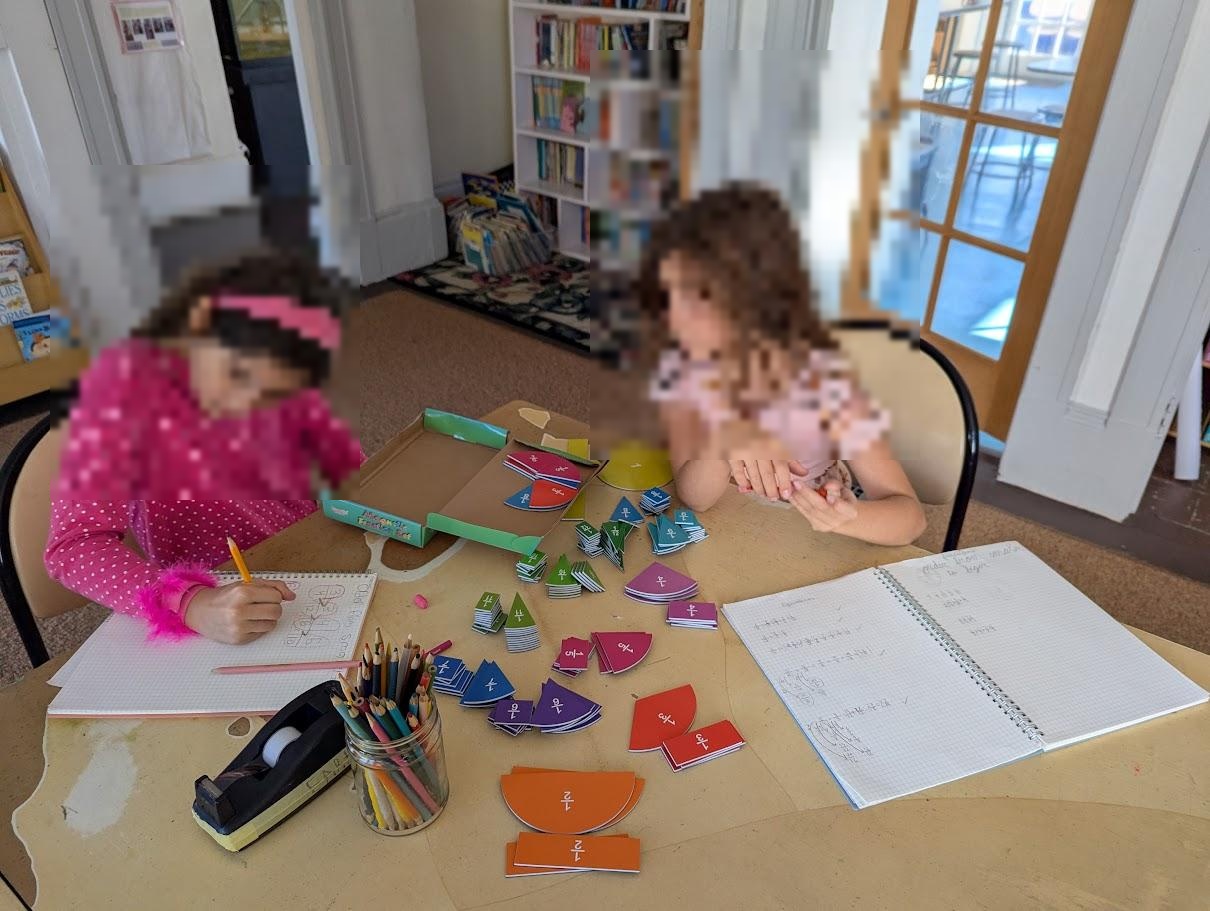
Before any formal explanation, we set up an environment. On the rug, we placed a rich collection of materials: fraction circles in multiple families, wooden pizza and cake slices, blank paper, colored pencils, small whiteboards, and number cards. No instructions. Just materials, space, and time.
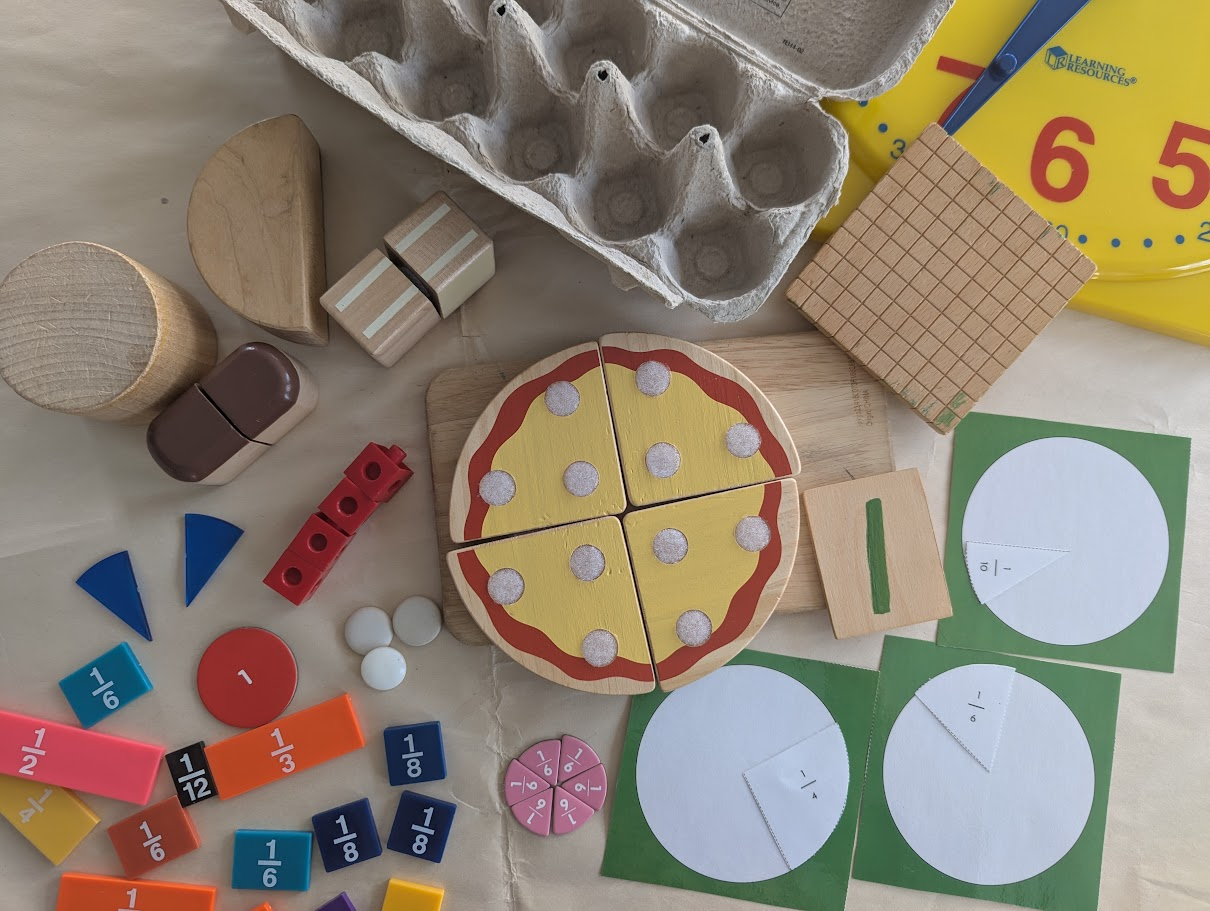
The choice of materials was deliberate. Fraction circles offered the abstract structure of equal parts. The pizza slices offered the familiar — something children know from life, from sharing, from hunger. Together, they created a bridge between the concrete and the conceptual.
In the Reggio Emilia tradition, the environment is understood as the third teacher — after the adult and the peer group. It is not a neutral backdrop; it is an active participant in learning. A well-prepared environment communicates values before a single word is spoken: it says that your thinking matters here, that your hands are tools for understanding, that there is no one right path through this space. The arrangement of these materials on the rug was itself a provocation — an invitation without a question attached. No child was told what to do with a fraction circle or a wooden pizza slice. The materials asked the questions. The children answered with their bodies, their conversations, and their attention.
Each material had been chosen to speak to a different level of understanding — and to a different age. The fraction circles are mathematically precise: equal in size, color-coded by family, designed to make the abstract idea of equal parts physically unavoidable. A child cannot make a whole circle with mismatched pieces; the material itself enforces the concept. The pizza and cake slices brought a different kind of intelligence — the knowledge children already carry from the table at home, from the question can I have another piece?, from the negotiation of fairness among siblings. The blank paper and colored pencils were there for a different purpose still: to invite representation, to create a space where children could externalize what they were seeing and thinking, to make the invisible visible. The whiteboards allowed for hypothesis and erasure — for the kind of provisional thinking that learning requires. Nothing in the environment was accidental. And nothing prescribed a single correct engagement.
First Encounters: Playing, Talking, Discovering
We observed and listened as children explored. They talked among themselves, moved materials around, and collaborated in ways we hadn't planned. Some gravitated toward the fraction circles, building and rebuilding wholes — noticing, with quiet satisfaction, how two halves fit perfectly into one circle, or how three equal pieces fill the same space.
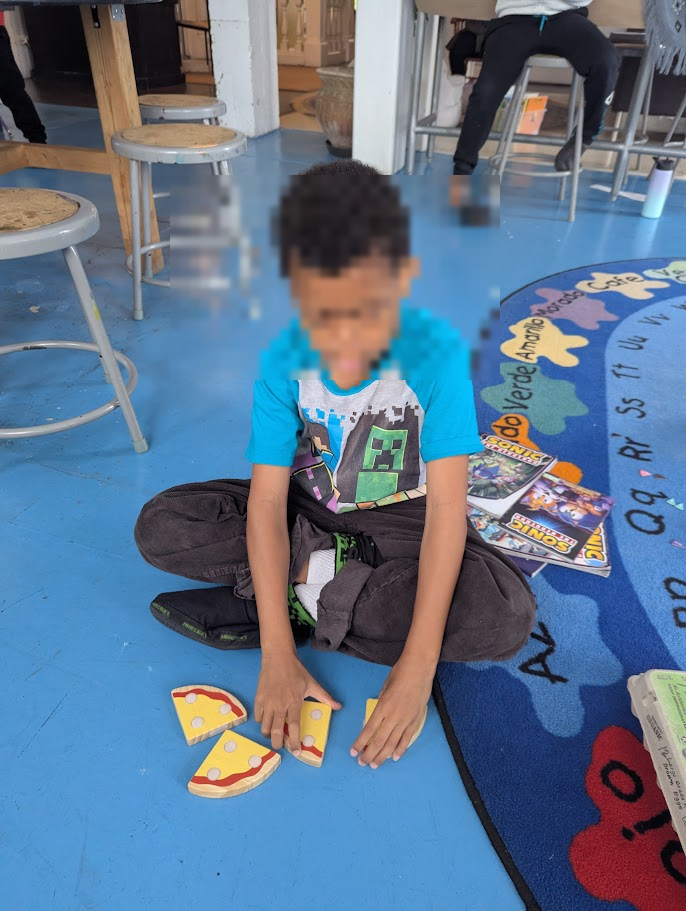
Others reached immediately for the pizza. This was the material that generated the most conversation — perhaps because it came loaded with real-world meaning.
"If we cut the pizza, we have fractions. If we take these two pieces we have half a pizza, if we just take this piece it's a quarter because we cut the pizza in 4 parts and we just take 1."
Catherine's explanation is remarkable in its precision. She is not reciting a rule — she is constructing one, live, in front of her peers. And she checks it against the physical object in her hands. This is mathematical thinking in action.
"We need to cut the cake in equal pieces to be fair."
Arody's comment brings in something the formal curriculum rarely names: the fairness of fractions. If the pieces are not equal, the fraction would not be fair or accurate. Children understand this intuitively.
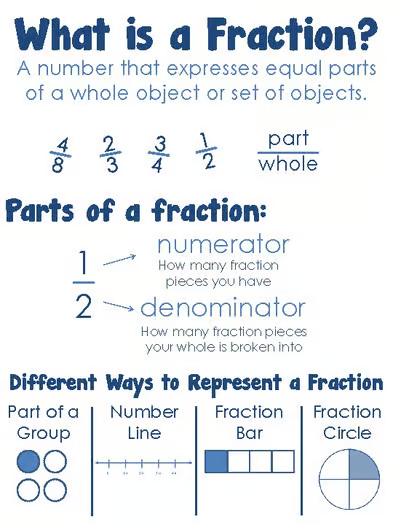
Arody's words became a natural gathering point. The teacher invited the whole group together and drew on a large sheet of paper: a whole circle, then a circle divided into two unequal parts, then one divided equally in half. Which of these is fair? Children responded immediately and with certainty — pointing, arguing, adjusting. From there, the teacher drew more examples: a whole pizza, half a pizza, a quarter. What makes each of these a fraction? What makes each cut fair? For the younger children, this was an exploration in the language of equal and unequal, of whole and part. For the older children, the teacher went a step further — introducing the words numerator and denominator, not as definitions to memorize, but as names for something the children had already been doing: counting the part they took, and counting all the equal parts in the whole. Then, at the end of this shared moment, the teacher paused and opened something new: How do we represent a fraction? How do we write it? Why do you think it looks the way it does? No answer was given. The questions were written on a card and pinned to the wall — an open invitation, a provocation to carry forward. These were questions the children would return to, in their own time, in their own way.
The Clock: Time, Fractions, and a New Language
The clock on the rug was not an accident. It was placed there deliberately — a provocation within the provocation, aimed especially at the older children. The idea was to offer a familiar object that carries fraction language inside it without anyone having named it as such: half past, a quarter to, a quarter past. Would the children notice the connection? Would they realise they had been speaking fractions all along, every time they told the time?
Lian noticed the clock first and asked about it. Children gathered around. Then Chelsea spoke:
"We can say it's 3 and a half because this is half the clock!"
Chelsea's observation opened a door. The clock face is a circle — and a circle, as the children had been exploring all morning, can be divided into equal parts. But the clock brought something new: it is divided into 60 minutes, not into the simple halves and quarters of pizza slices. This detail caught the attention of the older children immediately. If half the clock is 30 minutes, what is a quarter? What fraction is 15 minutes of a whole hour? What about 20 minutes — or 45? The familiar language of telling time — quarter past, half past, quarter to — suddenly revealed itself as fraction language. The same structure, the same logic, written into an object children look at every day. For the younger children, the clock confirmed what they were already discovering: that halves and quarters are everywhere, not just in food. For the older children, it became a doorway into more demanding territory — fractions of 60, equivalent fractions, and the question of how we name and represent parts of a whole when the whole is not a pizza or a circle, but time itself.
"Children learn by doing, by exploring, by experiencing, and by creating — not by being told."
Drawing to Think
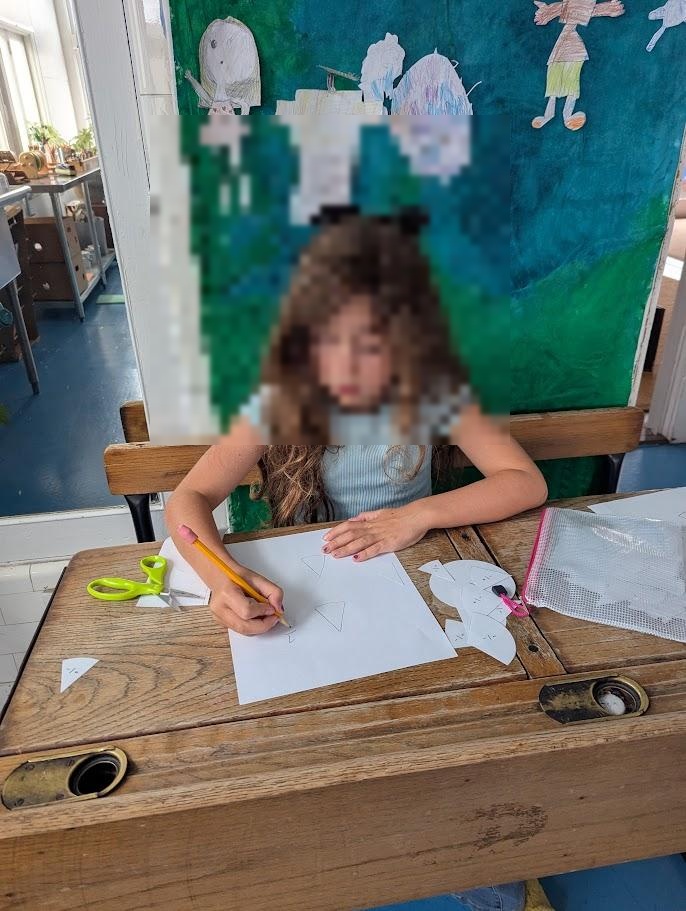
As the exploration deepened, many children moved to paper. Drawing became a way of fixing ideas, of slowing down thinking, of asking questions through image rather than word. We noticed something beautiful: children as young as four were drawing fractions with remarkable intention.
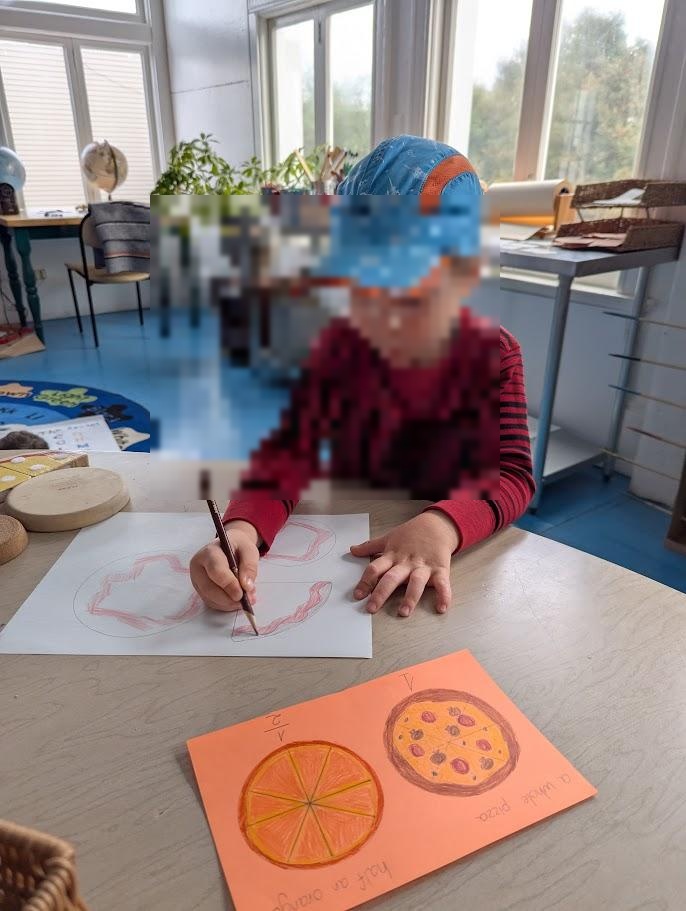
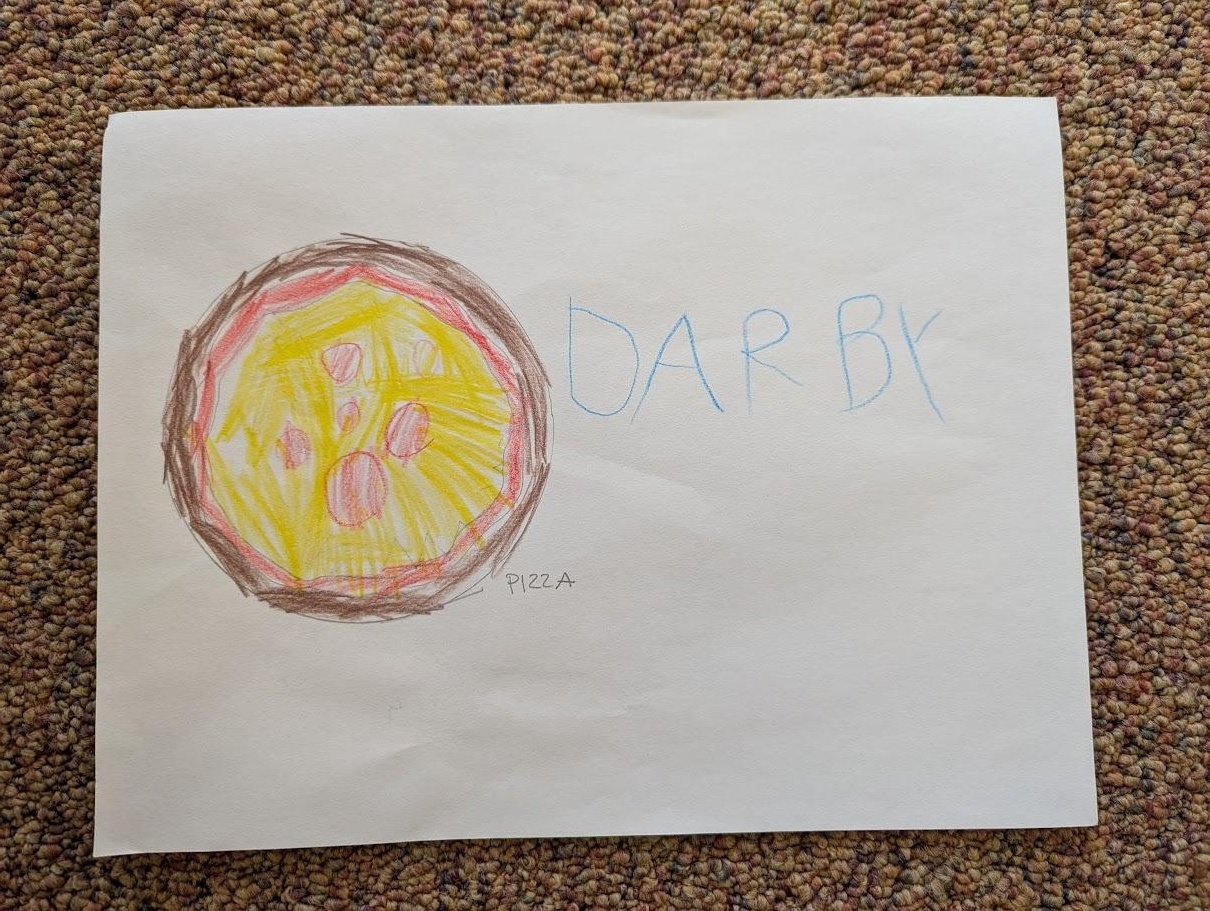
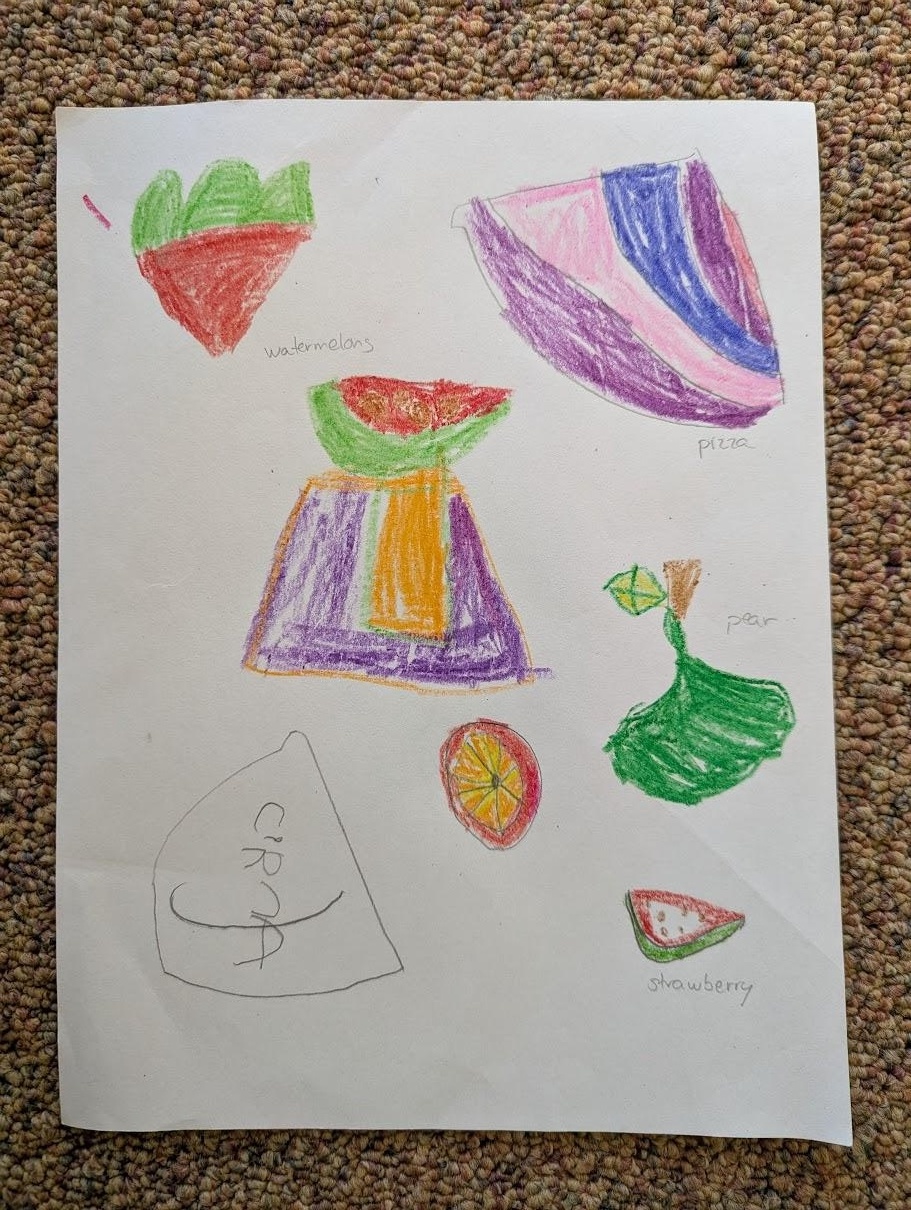
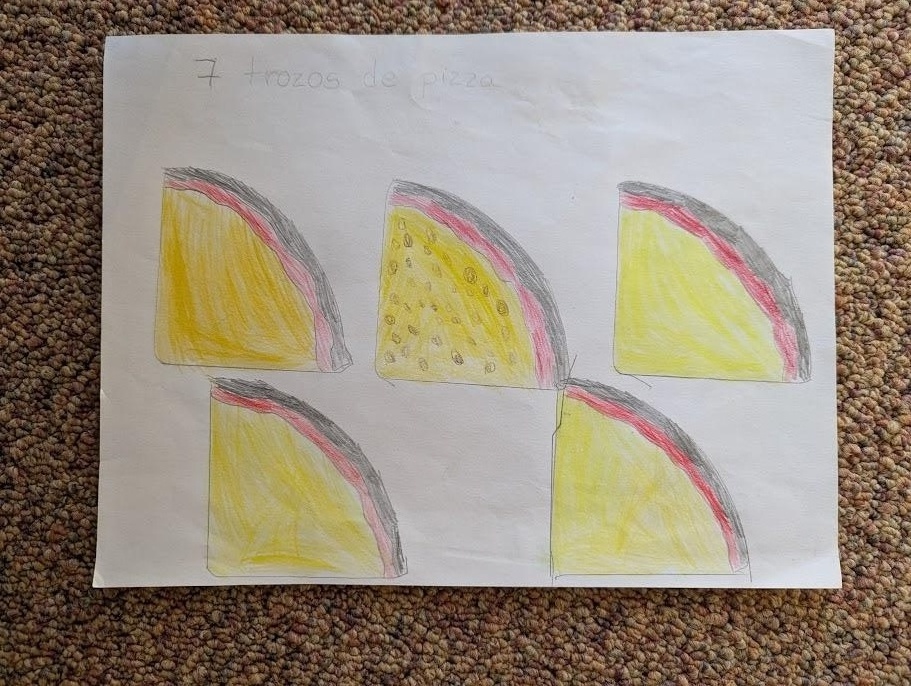
The drawings that emerged ranged from fully whole pizzas to careful fraction diagrams with labels. Each drawing was a window into a different level of understanding — and that variety was precisely the point of a multi-age environment.
"I'm drawing a whole pizza, half a pizza and a slice of pizza. What is the slice of pizza called?"
"I'm drawing many slices of pizza and then I'll have a whole pizza and more. Maybe two whole pizzas!"
"I can draw half a lemon, half an orange and a piece of watermelon."
"I just want to draw a whole pizza because I like pizzas a lot. My favourite is pepperoni pizza and this is what I'm going to draw."
Darby's comment is worth pausing on. A four-year-old choosing to draw a whole pizza, in the middle of a fractions exploration, is not "off task." Darby is asserting something: the whole exists before the part. And the whole is connected to desire, to love of pepperoni pizza. This is mathematical reasoning wrapped in four-year-old life.
"You have to put the pizza in the oven, even if it's just a slice."
The children's drawings were as varied as their ages and experiences. Some labeled their shapes formally; others titled them in Spanish and English. One child drew "7 trozos de pizza" (7 pizza slices) in careful pencil. Another illustrated fraction families — halves, thirds, fourths — as colored wedges, labeling numerators and denominators with beginning handwriting.
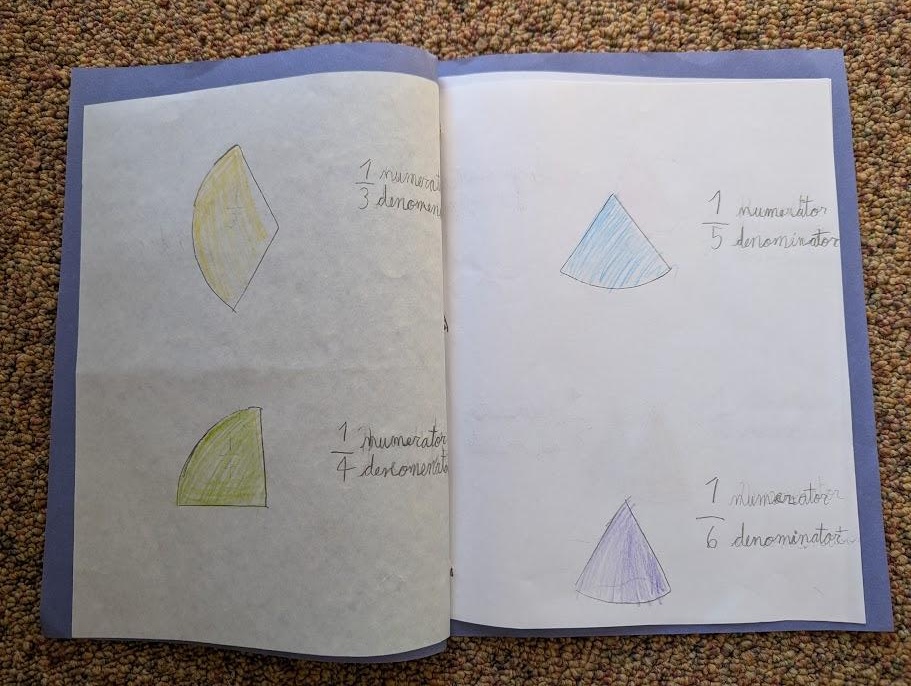
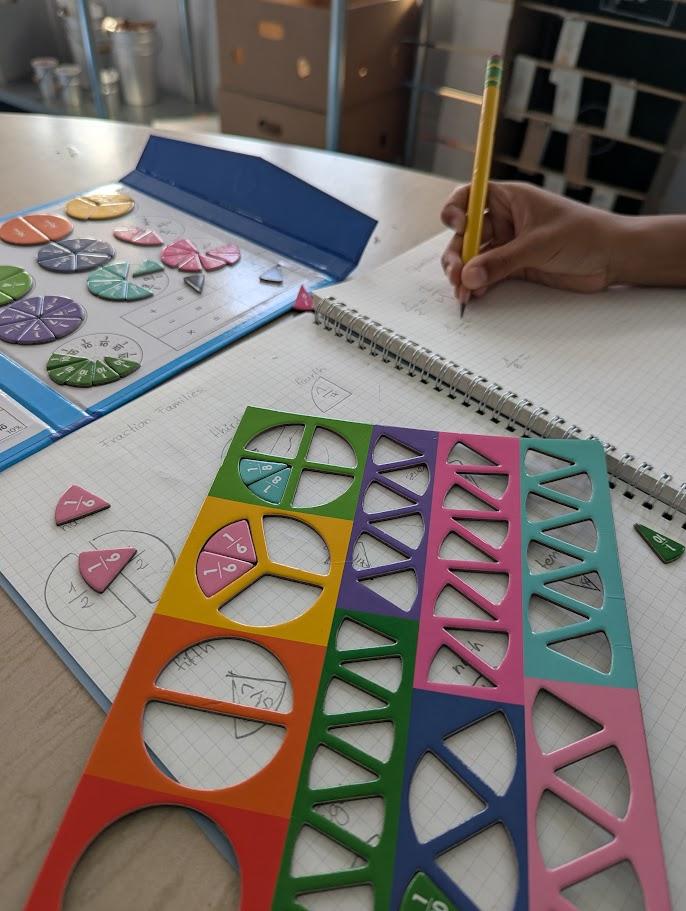
Enika's fraction book deserves its own moment. Having decided to document fraction families, she set herself the task of illustrating each family — halves, thirds, fourths, fifths, sixths — as a separate page, labeling numerator and denominator beneath each shape. This was not assigned. It was chosen.
And yet chosen does not mean alone. The teacher had been there throughout — observing, listening, staying close without intervening too soon. She had watched Enika move through the materials, noticed the moment her interest sharpened, read the signals that a child is ready to go further. When Enika reached the edges of what she could do on her own — uncertain about a label, unsure how to represent a particular fraction family, wondering whether her book was "right" — the teacher was there, precisely at that moment, to offer exactly the support she needed: a question that clarified without replacing her thinking, a word that named what she had already intuited, a small confirmation that let her continue on her own terms. This is what responsive teaching looks like in practice. Not a lesson delivered to a group, but a conversation held at the right moment with one child, in service of something she had decided mattered. The goal belonged to Enika. The teacher's role was to make sure she could reach it.
From Image to Symbol: How Do We Write a Fraction?
After sustained exploration with materials and drawings, the teacher brought a new question: How can we express that this is a fraction? How do we write it?
Children offered their ideas with confidence. No one waited for the right answer to be revealed — they reasoned together:
"We can trace one of 4 parts."
"We can just write 1 to make it easier, or 2 if you take 2 parts."
"You can make a drawing on the thing you're taking apart."
Then one child — who remembered working with fractions before — wrote a fraction on the board and explained that the fraction bar is like a dividing sign. The group held that idea. Is that right? Does it make sense? Is there a better way to express it? The conversation that followed was genuinely mathematical: children building consensus, testing notation, revising their thinking.
This moment stayed with the teacher. The children's genuine curiosity about why fractions are written the way they are — not just how, but why — pointed toward something deeper: the history behind the notation. That question, left open in the room, became the seed of a new plan. A few days later, the teacher prepared a session unlike anything that had come before: a story. She told the children about mathematicians in 12th-century North Africa and the Middle East — about Al-Hassar and the scholars of that era who first began writing fractions with a numerator, a line, and a denominator, a notation that slowly travelled across the Mediterranean and eventually became the way the whole world writes fractions today. The children were captivated — not just by the mathematical idea, but by the discovery that fractions had a birthplace, a history, people behind them. The story opened doors that a lesson could not: questions about trade routes and how knowledge travels, about who gets credited for ideas and who is forgotten, about what the world looked like in the 12th century and who was learning mathematics then. A provocation about notation had become, without being forced, an entry point into history, geography, and the history of science. This is what emergent curriculum looks like when it is followed with trust and care: one genuine question, pursued far enough, illuminates the whole world.
Fraction Families, Equivalence, and the Big Questions
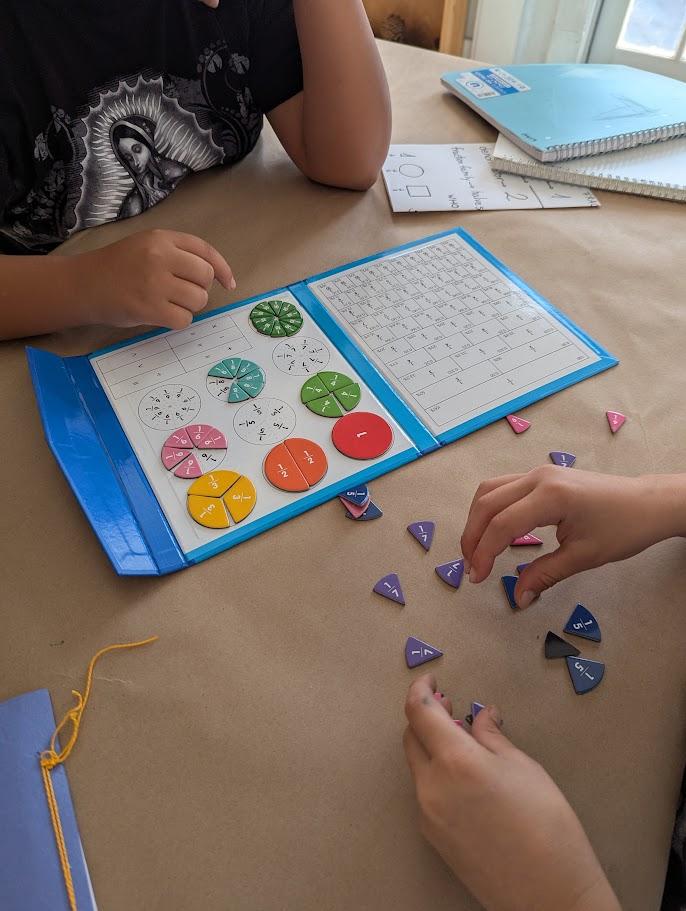
As the project continued, the children were ready for more. The environment evolved: fraction family sets, equivalence boards, and open notebooks joined the original materials. The questions grew harder.
What fraction is bigger? Can you order these fractions? Can we add or subtract fractions? How can we divide, share, and compare things?
These were not questions the teacher imposed. They were questions the children had arrived at themselves, through the accumulated weight of their own exploration. Having spent days handling, drawing, naming, and arguing about fractions, the older children had reached the natural edge of what simple manipulation could answer. They needed new tools — not to replace the concrete materials, but to go further with them. The teacher responded by enriching the environment rather than changing it: the same rug, the same open structure, but now with fraction rulers laid out alongside the circles, equivalence charts pinned at eye level, and notebooks left open as an invitation to record what was being discovered.
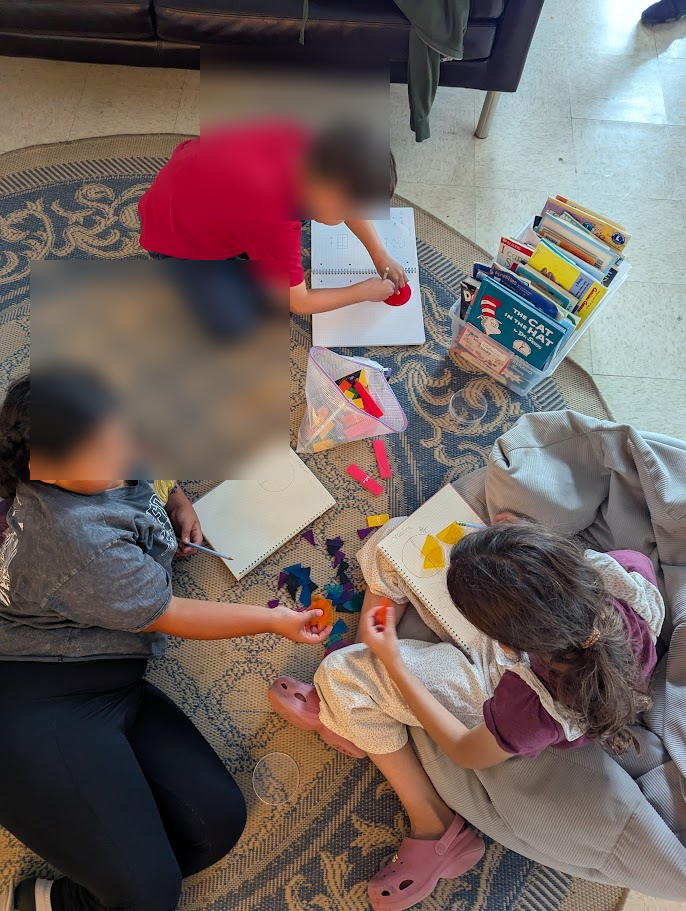
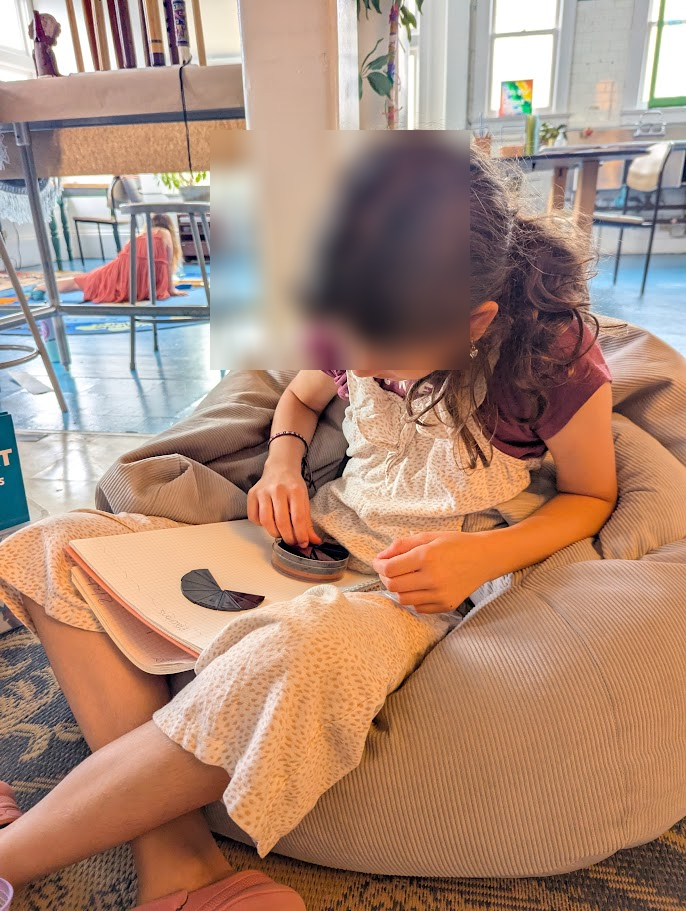
Children found answers not by being told, but by discussing, using materials, collaborating, and sharing their discoveries. The multi-age structure was essential: older children could model and explain; younger children could see where the thinking was going and feel invited, not excluded.
What makes this structure so powerful is precisely what makes it demanding to manage: every child is working at a genuinely different level, and every exchange between them has the potential to move thinking forward for both. A younger child asking a sincere question — but why are they the same? — pushes an older child to find an explanation that goes beyond reciting what they know. That effort of articulation is itself a deepening. Vygotsky called this the inter-psychological dimension of learning: understanding that begins in the space between people before it becomes the private property of any one mind. The rug was full of these moments.
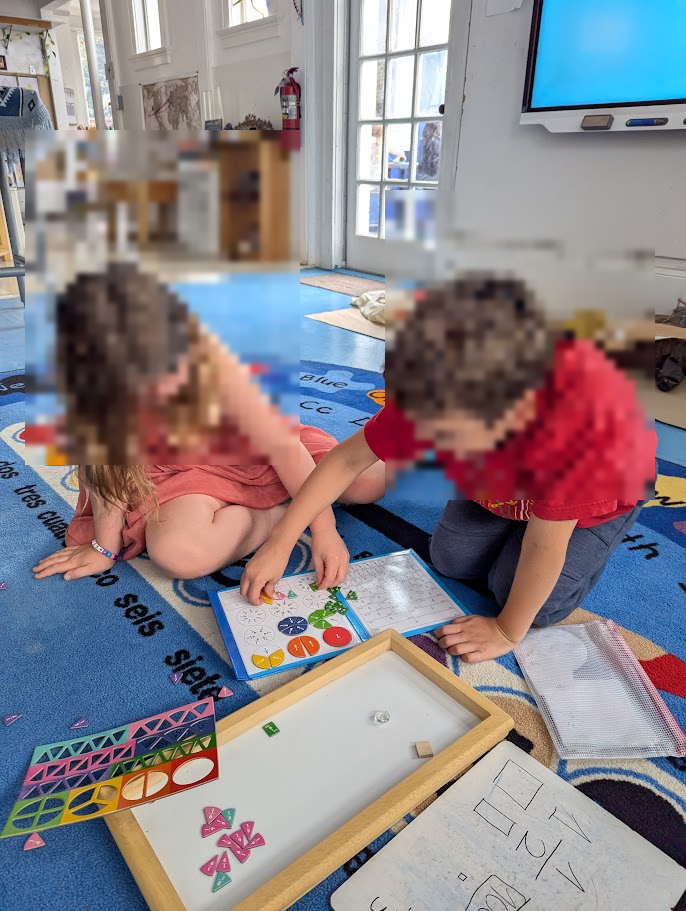
"I can put 2/6 in the place of ⅓ — this means they are the same."
"When I try 11/10 to the fifths places, there's one extra."
"⅔ is bigger than 2/4 — you can see it here and compare."
"These two are equivalent, right?"
"What do we do with the extra ones?"
"Here we have two wholes and some extra."
Ilo's discovery of equivalence is stunning in its directness: "I can put 2/6 in the place of ⅓ — this means they are the same." He didn't derive this from an algorithm. He placed one piece on top of the other and saw it. The abstraction followed the concrete.
Arody is working at the threshold of something more complex: improper fractions. "When I try 11/10 to the fifths places, there's one extra" — he is discovering, with his hands, what happens when the numerator exceeds the denominator. The piece doesn't fit. There is a remainder. He doesn't yet have the formal language for mixed numbers, but he has the concept: he can feel it as surplus, as something left over that doesn't belong to the whole. Catherine, working nearby, offers a different framing of the same idea: "here we have two wholes and some extra." Between the two of them, they are constructing the meaning of mixed numbers without being taught them. Lian's question — "what do we do with the extra ones?" — is not a sign of confusion. It is a mathematically precise question, one that points directly to the next stage of the work.
Elyse's observation about comparing fractions — "⅔ is bigger than 2/4 — you can see it here and compare" — is a quiet milestone. Comparing fractions with different denominators is, by any curricular standard, a challenging concept. It requires understanding that the size of a fraction depends not just on the numerator but on how many equal parts make up the whole. Elyse reached this understanding not through instruction but through side-by-side comparison of physical pieces. You can see it here. Four words that describe, with perfect accuracy, how mathematical understanding is built when children are given time and the right materials to think with.
Educator's Reflection
What made this project possible was not a particular lesson sequence, but a particular disposition: trust. Trust that children are capable. Trust that a four-year-old and a ten-year-old in the same room can both be genuinely challenged. Trust that a question left open is more powerful than an answer given too soon.
The multi-age structure was not an obstacle to be managed — it was a resource. Younger children were pulled forward by the language and thinking of older ones. Older children were pushed to articulate what they understood, which deepened their own comprehension. At no point did anyone feel left behind, because the materials met each child where they were.
Documentation gave us the tools to see what was happening. The photographs, the transcribed conversations, the drawings pinned to the wall — these were not just records. They were provocations in themselves: evidence that could be returned to, reflected upon, and shared with families as a window into genuine mathematical thinking.
The project is ongoing. The questions Lian, Arody, and Enika are asking now — about mixed numbers, about improper fractions, about addition and subtraction of unlike denominators — were not taught in a sequence. They grew, organically, from what children encountered, wondered about, and needed to know.
What I keep returning to is how much of this work happened in the in-between moments — not in the planned provocations, but in the pauses, the overheard conversations, the child who picked up the clock without being invited to. My role, more than anything, was to be present enough to notice. To watch Enika reach the edge of what she could do alone and be there — not too early, not too late — with the question or the word that let her go further. To hear in Arody's comment about fairness a natural gathering point for the whole group. To recognise in the children's argument about notation the seed of a history lesson. That quality of attention — sustained, unhurried, genuinely curious about what children are thinking — is, I believe, the most important thing a teacher can bring to a room.
This project also reminded me why I work across methodologies rather than inside a single one. The Reggio principles shaped the environment, the documentation, and the emergent quality of the planning. The Montessori materials — the fraction circles, the fraction family sets — gave children the precision their hands needed. Vygotsky was present every time an older child explained something to a younger one, or every time I chose to support rather than instruct. These are not competing frameworks. They are different lenses on the same truth: that children learn deeply when they are genuinely engaged, appropriately challenged, and trusted to construct their own understanding.
And then there was the 12th century. I did not set out to teach history in a fractions project. But when the children asked why fractions are written with a line between two numbers, I knew I could not answer with a rule. So I told them a story — about scholars in North Africa and the Arab world, about a notation that crossed the Mediterranean and became universal, about knowledge as something that travels and transforms. The children were still. They wanted to know more. Who were these mathematicians? Where did they live? What happened to their work? A question about symbols had opened, without force, into history and geography and the history of human knowledge. This is what I mean when I say that a well-followed question illuminates the whole world. You just have to be willing to follow it.
— Maria Galí Cabana
About This Documentation
This experience was documented at Katherine Michiels School, San Francisco, during the 2025 school year. Children ranged in age from 4 to 10 years old, spanning Pre-Kindergarten through Elementary levels. The project drew on Reggio Emilia principles — progettazione, provocation, and the hundred languages — alongside Montessori hands-on materials and a commitment to collaborative, child-led inquiry.
All photographs have been processed to blur children's faces. First names are used as they appear in the original documentation.